- Start small. When pitching a new deal make the prospect your friend. Sell your new friend something small they can use and use to validate all your fancy promises.
- Start well. If you don’t know who the client really is, what their relationship to you is or what their top 3 success factors are then stop and take the extra time to get those answers.
- Remember who’s vision is paying you. The client is not always right but being right is over-rated. The client’s needs always come first.
- Listen. You have 2 ears and one mouth. Use them in proportion. Not every similar sounding project should be solved in the same way.
- Educate and Bridge gaps. As a consultant looking to become a trusted advisor in a long term client relationship you are usually being paid for knowledge, services and vision that the client is unable or not willing to address.
- Start the relationship. Whatever the client asked for deliver that or the very first piece of that quickly.
- Show value. Visually depict what you mean.
- Be concise. People tune out of long winded documents and conversations.
- Be proactive in exploring scope but tie future recommendations back to what the client originally asked for as well as what prompted you to make that recommendation.
- Be strategic. The higher level conversation that solves the client’s overarching business problem in concert with regular tactical execution wins the day.
Author: gordon
-
10 things on being a consultant
-
Speed of Change
Yet another rif: on being human on one of my own rifs, namely that “technological change moves at a different speed than human change” (surprise). So periodically we need to course-correct and check in on humans as well as technology and see if we can’t keep them collaborating. Like any good relationship we need to constantly assess it in light of new information and events.
Microsoft notes that there is quite a lot of both excitement and trepidation out there around redefining HCI. I am glad about that. It means we have sat with our old ways of thinking and our old data>information>knowledge>wisdom systems for too long and that the only true to path to progress is constant assessment and change…all of which evokes a range of emotions in people.
The PDF is available for download. Are we ready to start looking at the psych-sociological underpinnings to our work in User Experience Design for 2020. I think so. Power to the “people ready” people! What do you think?
-
what’s important in design consulting
I have been thinking a lot about UX and Agile User Experience Design (read: smaller, faster, most instantly successful) business services.
Here’s my take on what we as a design community need to look at in 2008.
- Refresh the look ‘n’ feel and branding for clients – quickly
- Redesign the structure at a “screen’ and ‘map’ level -to show measurable ROI
- Strategy – the roadmap that will mediate our client’s future in these rocky times
-
Metrics to increase for our clients:
- Adoption
- Productivity
- Deployment rates
- Conversion rates
- Calls to action
- Effectiveness
- Efficiency
- Usability
- Satisfaction
- Adoption
- Refresh the look ‘n’ feel and branding for clients – quickly
-
Neudesic Austin UX event
The BIG EVENT…Come hear me talk and have a drink on us….
Wednesday, February 20, 2008
6:00 PM – 9:00 PM Cool River Cafe
4001 Parmer Lane
Austin, Texas 78727https://www.clicktoattend.com/invitation.aspx?code=124802 Recommended Audiences: Technology Executives, Vice Presidents, IT Directors, Marketing Executives, Business Decision Maker, Technical Decision Makers
Neudesic invites you to join them for User Experience 101 – what it is, what it does, and why it matters. This seminar is from Neudesic’s User Experience Practice which extends the reach, power and ultimate success of technology solutions. See and learn how you can quickly and easily leverage user research, interaction modeling, creative design and usability testing to optimize your own customers’ current software and web-based solutions. We will explain key disciplines within user experience including: • UX strategy – planning for your actual users
• Usability testing – QA before you think about any code
• Creative approaches to design – aesthetics, emotion, brand
• Information Architecture – blueprints, web/application maps, user flows, page template wireframes
• Design technology – building out experiences using new interface technologies Bring your users directly into your process and reap the rewards of effective, efficient and productive technology solutions. Come join us for cocktails and hors d’oeuvres during this interactive and informative event. If you would like to bring along a particularly difficult user experience design issue to discuss then we’d love to hear about it on the night and will have experts on hand to get you the answers you need. AND DON’T think “it’s yet another dull techie thing” – this is going to be fun! Please use the official sign up page so we can get a good number count on the bottles of wine: https://www.clicktoattend.com/invitation.aspx?code=124802 We look forward to seeing you there! -
The $10M Androids are coming!
Is anybody else getting this??? I’m not sure what to think about Steve Ballmer’s response. Maybe somebody will finally do something cool and useful in mobile technology?
You just have to come see what google is inventing these days! Who said Apple owned heart pounding launches? As I posted a little while ago. Google becomes Apple, Apple becomes… -
See! We can all get along.
So it was with great joy that I recently found this MSDN post that is from a newbie to UX, bless, who lives in the software world. He relates Software Architecture and User Experience to the same fabric of building good software. The comparisons are good (especially the table at the end) and may help me in better explaining what I do to those more “numerically and logically” inclined. His quote from a friend describing what you need to do get the UI right in a project is particularly enlightening: “…just have some graphical designers doing the UI with usability concepts in mind, some developers coding the behavior… and it’s done! The rest is solutions architecture as usual. How much more can you say about that? Maybe, updating the speech to the current line of products, you can mention Microsoft Expression for UI designers, Visual Studio 2008 for developers, XAML as lingua franca for both and that’s all, folks!”. Are there really folks like this still out there? This shows I have (a) a job for life and (b) a lot to still learn about my audience.
Wa-aaay back in 2006 Gartner published a report [PDF] basically saying the GUI is evolving in the direction holistic, humane UX is taking it. Mike Kuniavsky’s blog pulls out a summary. -
DO THIS, NOW!
 Summarized from the NYT Article by DAVID POGUE, Published: October 4, 2007 On November 12th, you’ll be able to buy a new laptop that’s spillproof, rainproof, dustproof and drop-proof. It’s fanless, it’s silent and it weighs 3.2 pounds. One battery charge will power six hours of heavy activity, or 24 hours of reading. The laptop has a built-in video camera, microphone, memory-card slot, graphics tablet, game-pad controllers and a screen that rotates into a tablet configuration. It’s an effort by One Laptop Per Child to develop a very low-cost, high-potential, extremely rugged computer for the two billion educationally under-served children in poor countries. The program is called “Give 1, Get 1” and it works like this. You pay $400 www.xogiving.org. One XO laptop (and a tax deduction) comes to you by Christmas, and a second is sent to a student in a poor country. THAT’s what you should be buying this Christmas! I just bought mine via paypal.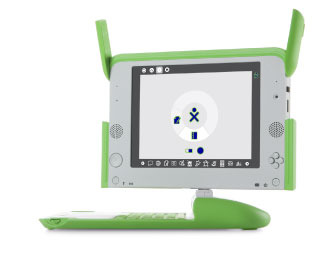
-
Change is hard for everybody
This all helps convince me how Agile as a methodology with it’s “work from a vision and do the next easiest set of things we can do” approach is going to end up dominating the way we do businesses and the old “build a big heavy plan and then try and live with it”. There is just something so beautiful about living in Agile and delivering the next set of small, incremental changes on a regular basis, knowing you’re part of a bigger guiding vision, not worrying too much about everyting that’s next until you really have to. The nicest thing for me about Agile User Experience is that we roll out a lovely carpet of successful options ahead of the development team to help guide them.
Change is always difficult and even more so in the technology and consulting game where we need to manage multiple requirements from multiple stakeholders. So it is rather enlightening therefore to compare how different organizations cope. Our pals at ZD net have an interesting post on how Apple, Microsoft and Ubuntu approach perhaps the most troubling change of all to technologists changing your O/S. -
Ireland is so hot right now (said in Zoolander voice)
Social Partnership:
Ireland is now one of the richest countries in the world. These are numbers for the whole populations. It depends how you slice these numbers up, of course. I have heard estimates that on a business scale Ireland has more wealthy people/companies than everywhere but Japan. Ireland produces most of the world’s software, having overtaken the US in about 2005. Again the numbers can be hacked around but the basic concepts are true. Ireland’s coming!
A significant part of Ireland’s recent economic success has been attributed to the “Social Partnership” – a formalized dialog between, the state, employers, unions and civil society actors. This dialog produces periodic binding agreements that cover minimum standards in pay, employment conditions, social welfare provision and specific parts of infrastructural development. In June 2006, a new partnership agreement (binding for the next 27 months) entitled Towards 2016 [pdf] was announced, setting the agenda for social and economic development for the next 10 years. Ireland and the EU:
Ireland’s membership of the EU has had a big impact on its political culture. One of the most obvious recent effects has been the influx of migrant workers from the ten EU accession states. An estimated 200,000 people have since moved to Ireland since June 2004 making it one of the largest recipients (per capita) of migrant labor in the EU. This has made a measurable impression upon the social and economic landscape. Ireland has recently opted to retain the work permit system for workers from Bulgaria and Romania when they join the EU. The 2004 Irish EU Presidency oversaw the agreement of the draft Constitutional Treaty. Following the French and Dutch referendum results, the June 2005 meeting of the European Heads of State, the Irish Government opted for a pause in the ratification process so as to allow time for reflection and debate in each Member State. It was also during Ireland’s EU Presidency in 2004 that the EU enlarged to encompass 25 Member States. And now (6-NOV-07)…Microsoft has confirmed its plans to built a $500,000,000 Data Center at Grange Castle in Dublin Ireland…count those zeros! “This is the first mega data centre deployment outside the US specifically targeted for the growth and performance of Windows Live services,” said John Mangelaars, vice president, Microsoft EMEA Online Services Group. Those of us who follow these things and have “folks on the ground” know that is no great surprise. Since the harmonization of the Republic of Ireland into Europe and the Euro and the 1998 Peace Agreement in the other country, Northern Ireland, the island of Ireland as a whole has attracted back more of its best and brightest than ever left. When I ran my small web consultancy in Ulster back in 2002 the main issues were lack of broadband infrastructure, lack of market maturity and importantly lack of people to hire. I tried hard on all three areas before returning to a “once in a lifetime” offer from a little outfit called Staples in Boston…but that’s a story for another day… The point here is that now Ireland is BOOMing. It’s full (and I mean FULL) of bright, young, native-English-speaking folks who are looking to the US for more inward investment and partnership. I say the US, which has always had a special relationship with Ireland (since we built their country for them 😉 now needs to look to their Celtic buddies as the doorway to Europe and drop the stereotypical “old country” and misty-eyed views of Ireland as a nice place to go for a pint or a fight…but they’ll keep that on the menu too if it’ll make you feel more at home…it’s all about hospitality over there 😉 -
Big methods
I don’t really agree Jakob, much as I adore you and your conferences and your fashionable glamor publicity shots. Well, ok. I sort of don’t agree. I am a strong advocate of the right tool for the job but simply advocating for a single large, monolitic usability service effort is like harking back to a single mainframe for the hardware world. Very appealing in a marketing sense. One machine in one room. Everybody obeys. We move on….hmmmm… The real world though these days (and it IS an ever more agile or as I like to say “humane design” world) demands fast, powerful services that inter-relate into a community of services and deliver a networked effective value. So I am for the aggregation of multiple, appropriate, guerrilla or light-weight methods that can be iterated rapidly, assessed, converted into coded solutions and repeated. We still do all the up-front thinking and planning but when it comes to getting it done – Let’s just go do it! Learn from any mistakes and Do it again.
So today the great man of usability says: High-Cost Usability Sometimes Makes Sense Summary: Computing the net present value (NPV) lets you estimate the most profitable level of usability investment. For big projects, expensive usability can pay off.
 Sentience and Intelligence Research